Search This Blog

Sunday, January 26, 2014

Break-Out from A Consolidating - Saucer Base Breakout


Stocks sometimes take time to consolidate and build a base before continuing their movement. This base allows time for the stock to take a breather and a chance for the sales and earnings to catch up to the new valuation of the stock. In many ways, it is similar to a long Continuation Pivotal Point in function, although the formation looks different, and it usually takes longer for the Consolidating Base to form.


When the Consolidating Base occurs, the same patience must be applied to the situation as required with the Continuation Pivot Point—don’t anticipate—rather wait for the stock to tell you by its action which direction it is going to go.

A common pattern of a Consolidating Base is called the saucer pattern. This pattern shows a slow, often long-term consolidating bottom that forms a kind of extended gradual change in trend as it develops into full maturity. To recognize this pattern, the trader must see a clear arc with tight trading ranges at the nadir, or bottom, of the arc.

As stated, this pattern is very similar to the Continuation Pivotal Points pattern, where the buyers and the sellers are about equal in power. The stock lags along, or languishes and consolidates, waiting for the next move. These extended consolidations often come at the end of long market declines or advances. But the key rule still applies: do not anticipate the next move—wait patiently for the market to tell you—to confirm the movement either up or down.

Saturday, January 25, 2014

Ideal Trigger Point 0011

Alliance Fiber Optic Products, Inc. (NASDQ: AFOP)  designs and manufactures components, modules, and subsystems that empower dynamic optical network, and facilitate the migration of fiber optics from the long haul through the last mile. They offer a broad range of products including interconnect devices that are used to connect optical fibers and components, couplers and splitters that are used to divide and combine optical power, and dense wavelength division multiplexing, or DWDM, devices that separate and combine multiple specific wavelengths.
Industry: Technology | Semiconductor - Broad line | USA

Jesse Livermore's Spikes and One-day Reversals


Jesse Livermore was very wary of any aberration in the price or volume of a stock that he was tracking. Sometimes, the price would spike, accompanied by abnormally heavy volume of at least a 50 percent increase over the average daily volume. This often led to what he named One-Day Reversals or trading climaxes. They often were like a red flag warning of a change of trend.

An aberration to him was any strong deviation from what was normal for the stock. He considered a spike in the stock price, high volume, as well as low volume, all aberrations, deviations from the norm. To him, these were possible danger signals, and often signals to exit a trade.

These spikes are often a reflection of exhaustion in the stock’s momentum, and they often appear at the end of a move, like a last gasp. They can provide a terrific signal for the observant, savvy trader.

A One-Day Reversal occurs when the high of the day is higher than the high of the previous day, but the close of the day is below the close of the previous day, and the volume of the current day is higher than the volume of the previous day.

It was Livermore’s belief that if you had the patience to sit with the stock all during its rise, now after the one-day reversal pattern appears you must have the courage to do the right thing and acknowledge this danger signal. You must now consider selling the stock, because you have received a valid warning signal.

Tuesday, January 21, 2014

How to understand Jesse Livermore's Continuation Pivotal Points


It is essential to understand that while the Reversal Pivotal Point marks a definite change in direction, the Continuation Pivotal Point confirms that the move is proceeding in the proper direction.

For Livermore, a stock’s price is never too high to Buy Long or too low to Sell Short. Waiting for these Continuation Pivotal Points signals gave him the opportunity to either open a new position or to add to a current position. But do not chase a stock if it gets away from you—let it go.

Livermore would rather wait and pay more, after the stock had regrouped and formed a new Continuation Pivotal Point, because this provides a confirmation and mental insurance that the stock will most likely continue with its move.

By correctly catching Continuation Pivotal Point, Livermore was able to make his initial purchase so that he had an entry point at the right price at the beginning of the move. This ensured that he was never in a loss position and could therefore ride out the normal stock fluctuations without risking his own capital. Once the stock had moved off the Pivotal Point Livermore was only risking his paper profits, not his actual capital, because he was “in profit” from the beginning of the trade.

Livermore defined Continuation Pivotal Point as a consolidation, which mean it is a range rather a specific price level. It gives the stock a chance to consolidate, often allowing a stock’s ratio of earnings and sales to catch up to its current price. It is usually a natural reaction in the stock’s progress. 

The Pivotal Point (either the Reversal or the Continuation point) is the only tip-off you need to trade and win. A trader has to be patient, because it takes time for a stock to run its logical and natural course to form a proper Pivotal Point, then breakout off its range. It will not be willed or forced forward by an impatient trader. It will come as a natural event. Be Patient!

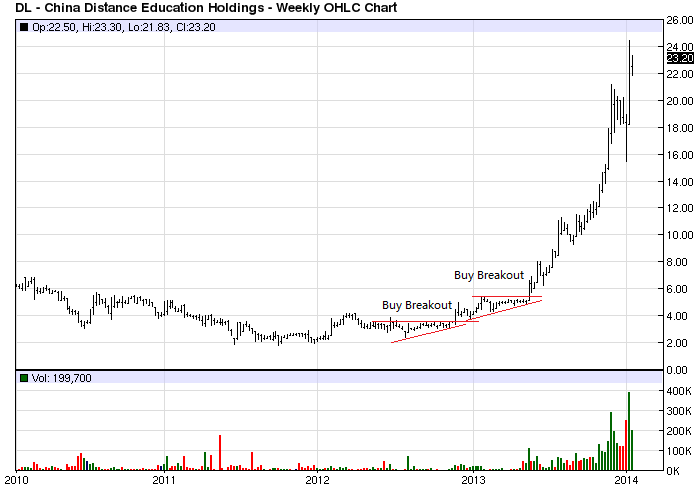
Ideal Trigger Point 0010

China Distance Education Holdings Limited (NYSE: DL) offers a range of online education and test preparation courses and other related services and products. Its courses are designed to help professionals and other course participants obtain and maintain the skills, licenses and certifications necessary to pursue careers in China in the areas of accounting, law, healthcare, construction engineering, information technology and other industries. CDEL Cayman also offers online test preparation courses to self-taught learners pursuing higher education diplomas or degrees and to secondary school and college students preparing for various academic and entrance exams. In addition, it offers online foreign language courses.

Industry: Services | Education & Training Services | China


Sunday, January 19, 2014

How to understand Jesse Livermore's Pivotal Points

Jesse Livermore's trading method (Pivotal Point Trading System or PPT) is very straight forward. It is easy for us as normal people to understand and even apply to achieve success. This system contained only three components, which are respectively known as the reversal pivotal point, the continuation pivotal point and the symptoms of weakness.

1. Reversal Pivotal Points

The very first component of Livermore’s PPT system is the reversal pivotal point, which is defined by himself as “the perfect psychological time to mark the beginning of a new move, representing a major change or reversal in a primary trend.” However, confirming a market reversal in real market is not that easy, e.g. when there is a big rally in a long bear market, how can you tell whether it is just temporary or the bull market has returned? Fortunately, Jesse already gave you some clues, you can use the following steps as your favors to justify:

1. The rally should be a intermediate trend (not minor trend) with volume increase, . 
2. The following correction(intermediate trend) does not get retraced below the rally's starting point. 
3. Few weeks later an even bigger rally follows. 
4. This time the volume of the subsequent rally is significantly higher than previous days. 
5. This subsequent rally breaks the trendline of previous bear market.

This monumental subsequent rally is exactly what Livermore called a reversal pivotal point, because it marks the return of large money back into the market.

2.Continuation Pivotal Points

The second component of Livermore’s PPT system is the continuation pivotal point, which focus on the time to re-enter into the new trend. While a reversal pivotal point marks a trend reversal, a continuation pivotal point confirms that the trend continues.

After the breakout of previous bear market trendline, usually the market will form a consolidation which is known as the accumulate process or the preparation of the new take-off .This breakout from consolidation is the continuation pivotal point, where a trader should get in and follow it. Most importantly, just as for a reversal pivotal point, a true breakout at a continuation pivotal point is usually accompanied with a higher volume than the previous few days.

Buy at breakout off a consolidation is one the greatest secrets in trading stocks. It can help maximize your profits and minimize your risk at the same time.

3.The Symptoms of Weaknesses

The final part of Livermore's PPT system is called the symptoms of weakness, which tells you when to exit the market.

Symption 1: Failed Rallies-----After an overall head is formed, the subsequent rallies often end with a weak momentum, Failed to make a new high and volume decreased.

Symption 2: High End Price Consolidation (Distribution)-----The volume during this period of time is very high. After distribution, the price would breakdown and downtrend formed.

Summary

Over his entire legendary career, Jesse Livermore obtained two important insights in trading: firstly, he often lost when he entered a position before a pivotal point was formed and secondly, the big money could only be made by capturing big trends, Thus he developed the discipline to avoid any personal opinion until a pivotal point appeared, as well as to hold onto his positions until market was shown the symptoms of weakness.
In short, this is how Livermore traded:

1. Trend confirmation: he never trade against the trend as indicated by the reversal pivotal points.
2. Careful entry: He only entered the market when a sound breakout appears. 
3. Let the winners ride: He held onto his positions until the symptoms of weakness appeared.


Ideal Trigger Point 0009

Methode Electronics Inc.(NYSE:MEI) is a manufacturer of component & subsystem devices with manufacturing, design & testing facilities in China, Egypt, Germany, India, Italy, Lebanon, Malta, Mexico, Philippines, Singapore, Switzerland, United Kingdom & United States. It designs, manufactures and markets devices employing electrical, radio remote control, electronic, wireless and sensing technologies. Its components are found in the primary end markets of the aerospace, appliance, automotive, construction, consumer and industrial equipment, communications (including information processing and storage, networking equipment, wireless and terrestrial voice/data systems), rail and other transportation industries. Its business is managed on a segment basis, with those segments being Automotive, Interconnect, Power Products and Other. 

Industry: Technology | Diversified Electronics | USA


Saturday, January 18, 2014

Some Misunderstandings of Jesse Livermore's Timing


Livermore always considered time as a real and essential trading element. He often said: “It’s not the thinking that makes the money—it’s the sitting and waiting that makes the money.”

But this often has been incorrectly interpreted by many people. They thought Livermore would buy a stock and then sit and wait for it to move. This is completely not so. What he really meant was there were many occasions when he should sit and wait in cash, until the right situation appeared. 

When all these conditions came together and when as many of the odds as possible were in his favor, then and only then, like a sniper, he would pull the trigger, usually with great result.

After triggering, if everything did as normal as it should be, Jesse would never consider sell until something abnormal appear.

The hardest part of his timing is patience. If you want to achieve great accomplishments, you must learn to be very patient, wait for the opportunity come to you.